
dentico didact no. 1-5
Lara Rosa
January 30 – February 15, 2026
Stump Gallery is pleased to announce dentico didact no. 1-5, the inaugural solo exhibition of Lara Rosa. Teeth are made up of the substance hydroxyappetite. All parts of the teeth are alive. Similar to an organ, they are a type of tissue, not a bone. They masticate – they are the tools which destroy in order to build back up. They are the front lines of a chain reaction which reallocate nutrients throughout the body. These tools are innervated with sensory neurons, tools that do not cleanly demarcate between self/not self, that which is used and that which does the using. Food enters the mouth, saliva is mixed with the food to form a bolus. The trachea is blocked so that we don’t breathe in our food down into our lungs. Once the bolus proceeds past the throat, the parasympathetic nervous system kicks in, for which the final stretch to the stomach is completely involuntary.
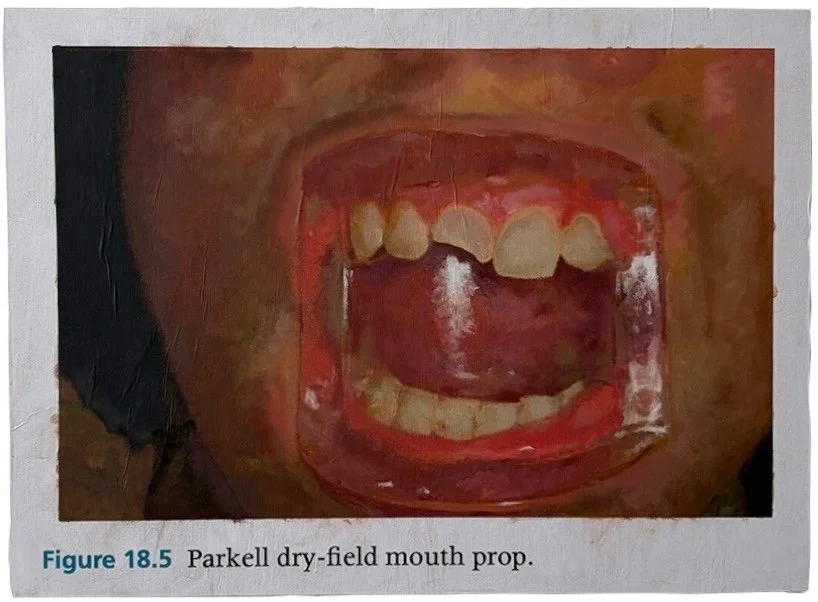
The images taken from the Handbook of Clinical Techniques in Pediatric Dentistry by Jane A. Soxman are part of a tradition of art that styles itself as pedagogy, such as Young Read ers Press First Dictionary illustrated by John Seares Riley. By separating these images from their original form, the question of authorship is reintroduced. More so than art, science has tried to position itself as objective and process-driven, consciously de-emphasizing the discoverer, the analog for the creator or author in art. Famously, the Krebs Cycle was renamed the Citric Acid Cycle in order to promote a sense of collective discovery among students.
What does the myth of the tooth fairy promise? In one sense, the myth of the Tooth Fairy is to sublimate the symbolic loss (of innocence, of health, of purity) into gift, which Jean Bau drillard would call symbolic exchange. Symbolic exchange, broadly defined, is a social re lation in which cultural, sentimental or traditional value is centered over exchange-value1. Capitalist logic is tightly bound up with the social contract tradition, in which individuals see each other as free and separate agents entering into equally and mutually beneficial
contracts with clearly demarcated spatio-temporal terms, with the money form serving as the great equalizer.
The social contract framework is not useful or neutral to those oppressed by racial capital ism. Non-capitalist societies existing today as gifting-economies, feudalism, or the familial relationship would be prime examples of symbolic exchange in act. Symbolic exchange disabuses us of what Marx identifies as the myth of equivalent exchange. Consequent ly, symbolic exchanges do not need to be quantifiable or stable. Such exchanges are more fluid, often occur over a longer period of time and instantiate many such exchange “events” which resist systematization.
Teeth are ripe for symbolism. So long as access to dental care is behind a paywall, they are a class-signifier. Teeth are an intimate exposure of the structure – the skull – in a way that is unique to our corporeal reality. The body itself is a complex admixture of self/ non-self, voluntary/involuntary, in which a kind of bargaining often occurs between its needs and our desires. For Baudrillard, bargaining was the relational modality present during a sacrifice for the Gods. It is death’s absolute nature and irreversibility that besets the system: it cannot be exchanged on the marketplace. As Baudrillard states, “Nothing corresponds to death except death.”2 This is why he identifies sacrifice (symbolic death) as a means of political rebellion. Metaphorically, it pushes us to imagine radical ways of engaging beyond the economic and underscores the import of exchanges that have little to no possibility for equal remuneration.
Text by Lara Rosa
Lara Rosa (b. 1998) is a philosopher and artist from Tijuana, B.C., Mexico. She is earning her master’s degree in philosophy at Columbia University. She is a resident oil painter at Future Space Studios in Ridgewood and a contributor to MODA Critical Art Review.
1 Baudrillard, Jean, Symbolic Exchange and Death, 22
2 Baudrillard, Jean, Symbolic Exchange and Death, 50
Lara Rosa, dentico didact no. 4, 2026, 16 x 12 inches (40.6 x 30.5 cm) Oil paint, wheat paste, paper on wood panel